Introduction
Storing data is one of the most common requirements in software development,
and at some point you will hit a TransactionRequiredException when trying to persist an entity in Quarkus:
public void save(Car car) {
    car.persist();
}
The fix is straightforward: add @Transactional to your method:
import jakarta.transaction.Transactional;

@Transactional
public void save(Car car) {
    car.persist();
}
But understanding why it is required and what happens behind the scenes is what separates someone who uses the annotation from someone who truly understands it.
In this article, we will explore how @Transactional works in Quarkus and how it integrates with CDI (Contexts and Dependency Injection),
JTA (Jakarta Transactions API), Hibernate ORM and Agroal to manage database operations within a transaction.
The Jakarta Transactions API
Jakarta EE is built on top of specifications; in turn, Quarkus is built on top of Jakarta EE specifications and community standards. Each specification defines a set of APIs. I like to say that specifications are like contracts (a big PDF file) that define how things should work, and the implementations are the actual code that makes things work. Quarkus uses the Narayana JTA transaction manager as the implementation of the Jakarta Transactions API (JTA).
The Jakarta Contexts and Dependency Injection (CDI)
CDI is also a Jakarta EE specification. It defines how beans are created, managed, and injected into other beans. Quarkus uses ArC as the implementation of the Jakarta CDI specification. ArC performs bean discovery and wiring at build time, which is one of the key reasons Quarkus starts so fast. CDI also defines the concept of interceptors, which are used to separate cross-cutting concerns (like transactions) from business logic.
Hibernate ORM
Hibernate ORM is not a Jakarta EE specification itself, but it is the reference implementation of the Jakarta Persistence (JPA) specification. It is responsible for mapping Java objects to database tables and managing their lifecycle. Quarkus integrates Hibernate ORM through the quarkus-hibernate-orm extension, which configures and boots Hibernate at build time to further reduce startup time and memory footprint.
Agroal
Agroal is a modern, lightweight JDBC connection pool. A connection pool is a cache of database connections that can be reused, improving performance and resource management. It is the default connection pool used by Quarkus, integrated through the Quarkus JDBC extensions.
Let's begin transactions
In the context of databases, a transaction is a sequence of operations performed as a single logical unit of work, and it has properties known as ACID (Atomicity, Consistency, Isolation, Durability).
SQL
Below is an example of a DB transaction in SQL:
BEGIN TRANSACTION;
INSERT INTO cars (plate) VALUES ('ABC-1234');
INSERT INTO cars (plate) VALUES ('DEF-5678');
COMMIT;
You have the BEGIN TRANSACTION statement to start the DB transaction, then a series of insert operations, and finally the COMMIT that ends the transaction committing the changes to the database. You can also use a ROLLBACK to end the transaction without committing.
Understanding two types of transactions
In Quarkus and Java applications, we work with a higher-level abstraction through the Jakarta Transactions API (JTA). It is important to understand that there are actually two types of transactions at play when you use @Transactional:
- DB Transaction (Database-side): The actual transaction in the database, managed through JDBC. This transaction starts lazily when your code actually needs to interact with the database.
- Narayana Transaction (JVM-side): Managed by the JTA implementation. This transaction starts eagerly when the
@Transactionalinterceptor executes, updating theTransactionManagerand CDI context to signal that there is an active transaction scope for external calls (in our case DB) to enlist operations into.
For the rest of the article, we will refer to the first one as DB transaction and the second one as Narayana transaction to avoid confusion.
@Transactional
The @Transactional annotation is part of the JTA specification (Transactional Annotation 3.7):
The
jakarta.transaction.Transactionalannotation provides the application the ability to declaratively control transaction boundaries on Jakarta Context Dependency Injection managed beans, ...
In other words, when you annotate a method with @Transactional,
you are telling Quarkus that this method should be executed within a Narayana transaction:
@Transactional
public void save(Car car) {
    car.persist();
}
No DB transaction is started at this point, and no SQL reaches the database yet.
The power of CDI Interceptors
CDI Interceptors are part of the Jakarta Context Dependency Injection specification, which says that:
... Interceptors are used to separate cross-cutting concerns from business logic. The Jakarta Interceptors specification defines the basic programming model and semantics, and how to associate interceptors with target classes.
When developing any application, you will have some cross-cutting concerns, such as logging, tracing, security, and in our case, transactions. Mixing cross-cutting concerns with business logic will make your code a Big Ball of Mud, and it will be hard to maintain and test.
An interceptor wraps your code and executes some logic before and after the method call. In our case, the interceptor manages the Narayana transaction lifecycle: it starts the transaction before the method execution, commits it after successful completion, and rolls it back if an exception is thrown.
Transactional Interceptor
During build time, Quarkus registers a CDI interceptor for each @Transactional type (TxType) defined in the JTA specification, such as REQUIRED, REQUIRES_NEW, MANDATORY, etc.
This means that when a CDI managed bean method is called, the interceptor executes first:
public abstract class TransactionalInterceptorBase implements Serializable {

    @Inject
    TransactionManager transactionManager;

    public Object intercept(InvocationContext ic) throws Exception {
        final TransactionManager tm = transactionManager;
        final Transaction tx = tm.getTransaction();
        // omitted code
        try {
            return doIntercept(tm, tx, ic);
        } finally {
            // omitted code
        }
    }
}
The intercept method is the entry point of the interceptor.
It gets the TransactionManager and the current Transaction,
and then delegates to the doIntercept method, which contains the actual logic for managing the transaction lifecycle based on the TxType.
The InvocationContext parameter contains the context of the method being intercepted, such as the method name, parameters, etc.
It calls ic.proceed() to execute the actual business method, and it can also catch exceptions to decide whether to commit or roll back the transaction.
This code was extracted and simplified from the Quarkus Narayana JTA extension. You can check the source code for more details.
Hibernate and JTA
In Hibernate, a Session object is the main object responsible for managing entities, executing database operations, etc.
When using .persist() from PanacheEntity, behind the scenes you are using a TransactionScopedSession that automatically joins the Narayana transaction when it is constructed.
When you try to do a database operation like .persist(), the TransactionScopedSession checks if there is a current Narayana transaction.
If there is, it creates a real Hibernate session bound to that scope and proceeds with the database operations.
Importantly, the TransactionScopedSession does not directly manage DB transactions.
When the session needs to interact with the database, it requests a JDBC connection from Agroal,
which will then start the DB transaction and enlist the connection into the Narayana transaction.
See the full code in the source code.
Integration between JTA, Hibernate ORM, and Agroal
Now that we understand each piece, let's walk through the complete flow from @Transactional to the actual database operation:
@Transactional
public void save(Car car) {
    car.persist();
}
The Complete Transaction Flow
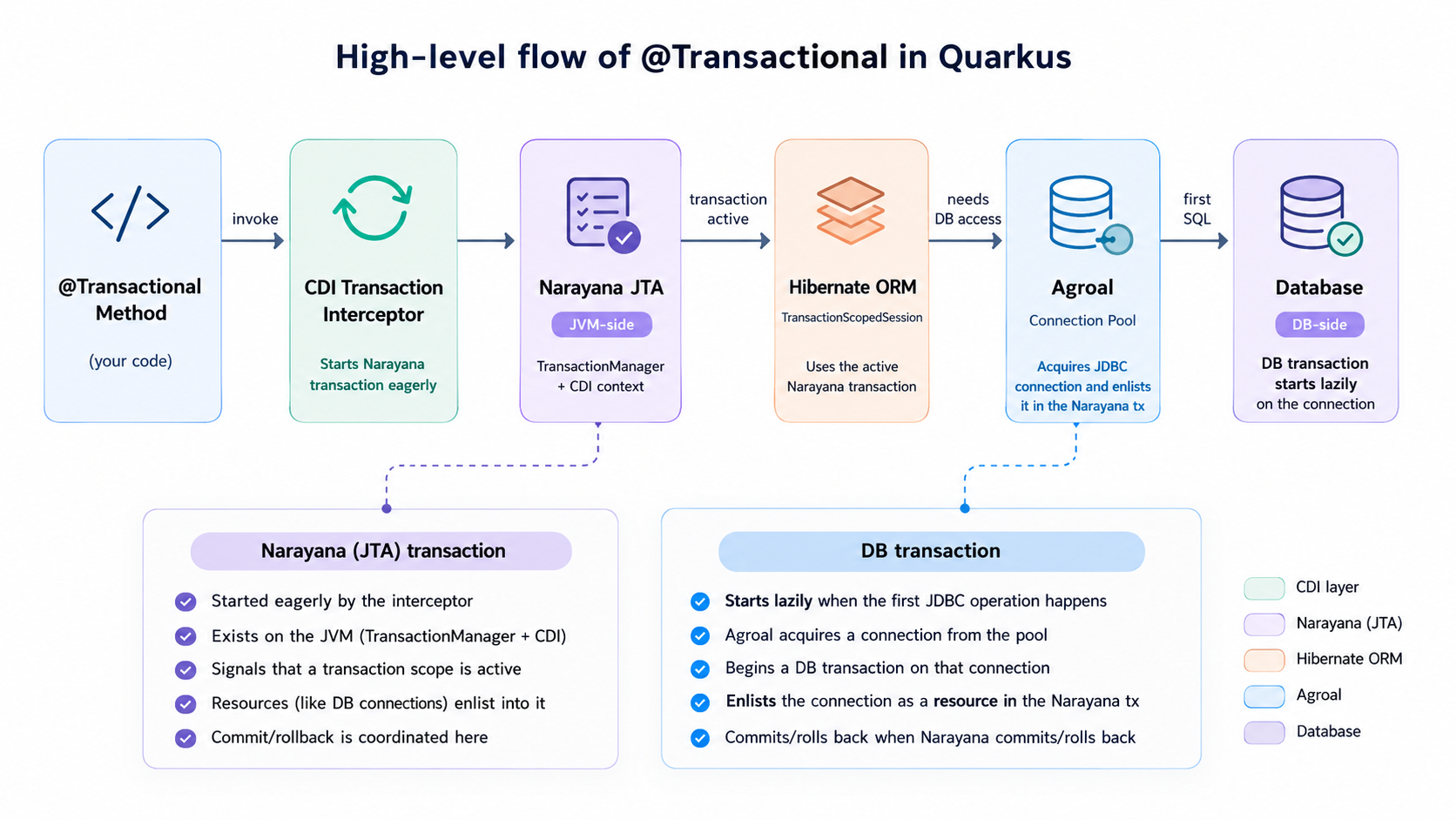
-
@TransactionalInterceptor Executes: The CDI interceptor checks whether there is already an active Narayana transaction. ForTxType.REQUIRED, it starts a new Narayana transaction if there isn't one already active. -
Method executes: The method annotated with
@Transactionalstarts executing inside the active Narayana transaction. No SQL has been sent to the database yet, and no JDBC connection has been acquired. -
persist()called: Hibernate ORM'sTransactionScopedSessiondetects the active Narayana transaction and creates a real HibernateSessionbound to that transaction scope. -
Database access needed: When
persist()eventually needs to interact with the database, Hibernate ORM requests a JDBC connection from Agroal through aConnectionProvider. -
Agroal enlists the connection: Agroal detects that there is an active Narayana transaction but no JDBC connection enlisted in it yet. Agroal acquires a JDBC connection from the pool, starts the actual DB transaction on that connection (this is when DB transaction effectively starts), and enlists the connection as a resource in the Narayana transaction.
-
SQL executes: Hibernate ORM proceeds with the
INSERToperation using the enlisted JDBC connection. The SQL now executes inside the active DB transaction managed by the database connection. -
Commit phase: Once the method completes successfully, the interceptor commits the Narayana transaction. The Narayana transaction manager then coordinates all enlisted resources and instructs them to commit. Agroal delegates this operation to the JDBC connection, which executes the actual
COMMITon the database, finalizing the DB transaction.
Conclusion
In this article, we explored the @Transactional annotation in Quarkus and its importance in managing transactions. We learned that there are two types of transactions at play:
- Narayana transactions (JVM-side): Starting eagerly when the
@Transactionalinterceptor executes. - DB transactions (database-side): Starting lazily when the first database operation occurs.
We saw how CDI interceptors manage the Narayana transaction lifecycle and how Hibernate ORM and Agroal coordinate to execute database operations within it. The key insight is that Agroal bridges the gap between the JVM-side Narayana transaction and the database-side DB transaction, enlisting connections as resources when they are needed.